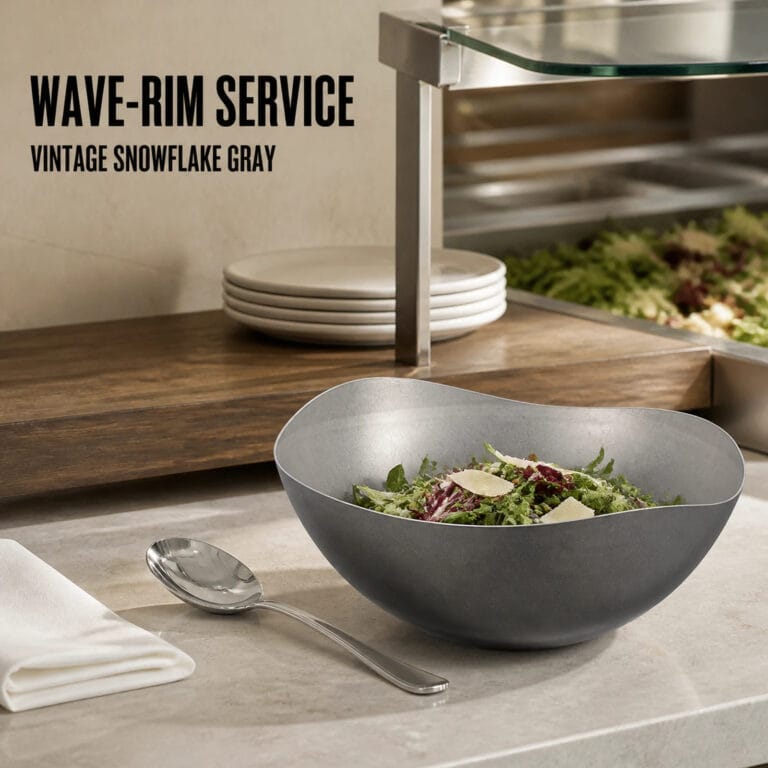
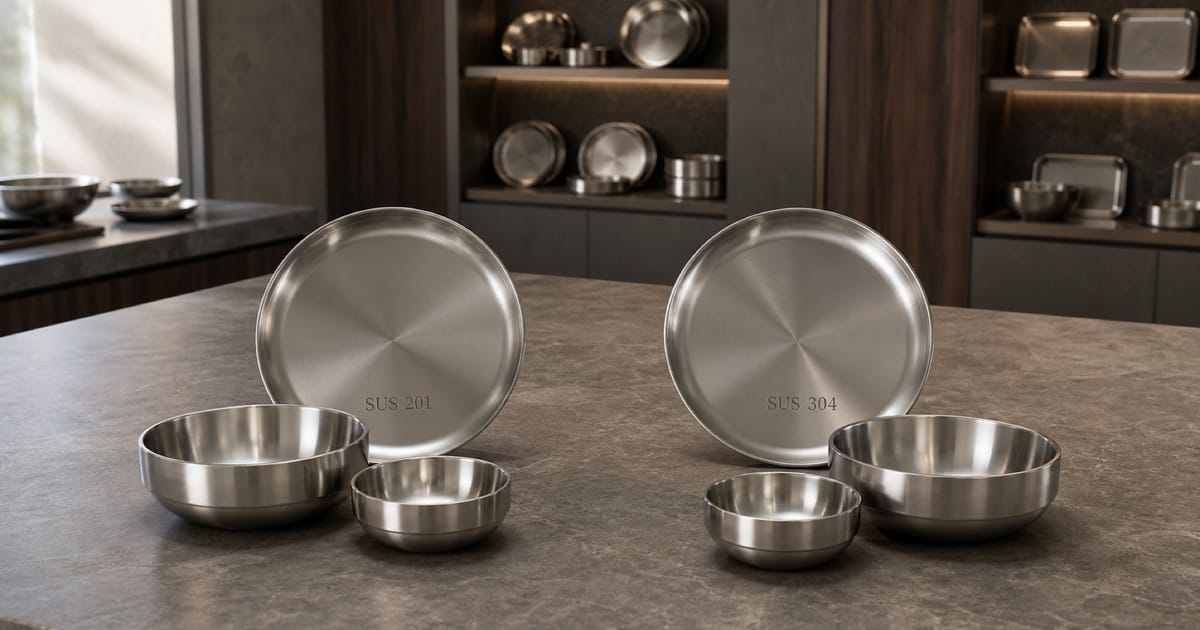
201 and 304 are the two most common stainless steel grades used in tableware wholesale: 201 is a cost-effective austenitic grade with lower nickel and higher manganese, while 304 (18/8 or 18/10) offers better corrosion resistance and a brighter finish. For reference, our range includes 304 double-wall kids bowl and vintage gray irregular rim bowl as standard production options.
When you source stainless steel tableware wholesale, two grades dominate the quotes you’ll get: 201 and 304. They can look almost identical on the shelf, but they differ in cost, corrosion resistance, and longevity — and that difference matters both for your margin and for the trust your buyers place in you. This guide breaks down 201 vs 304 in plain terms, and shows you how to make sure you actually get the grade you pay for.
We manufacture tableware in both 201 and 304 as our standard grades (and in 430, 316L, and tri-ply on request), exporting to Europe, North America, Japan, Korea, and across Asia for over 10 years — so this is the same comparison we walk buyers through every week.
The quick answer
- 304 = the premium, food-grade standard. Best corrosion resistance and finish. Costs more (it contains more nickel). The safe default for hospitality, export to the EU/US, and demanding daily use.
- 201 = the cost-effective option. Lower nickel, higher manganese. Good for budget lines and price-sensitive markets, but less resistant to corrosion over time.
Both are usable for tableware. The right choice depends on your market, price point, and how the items will be used.
What’s actually different: composition
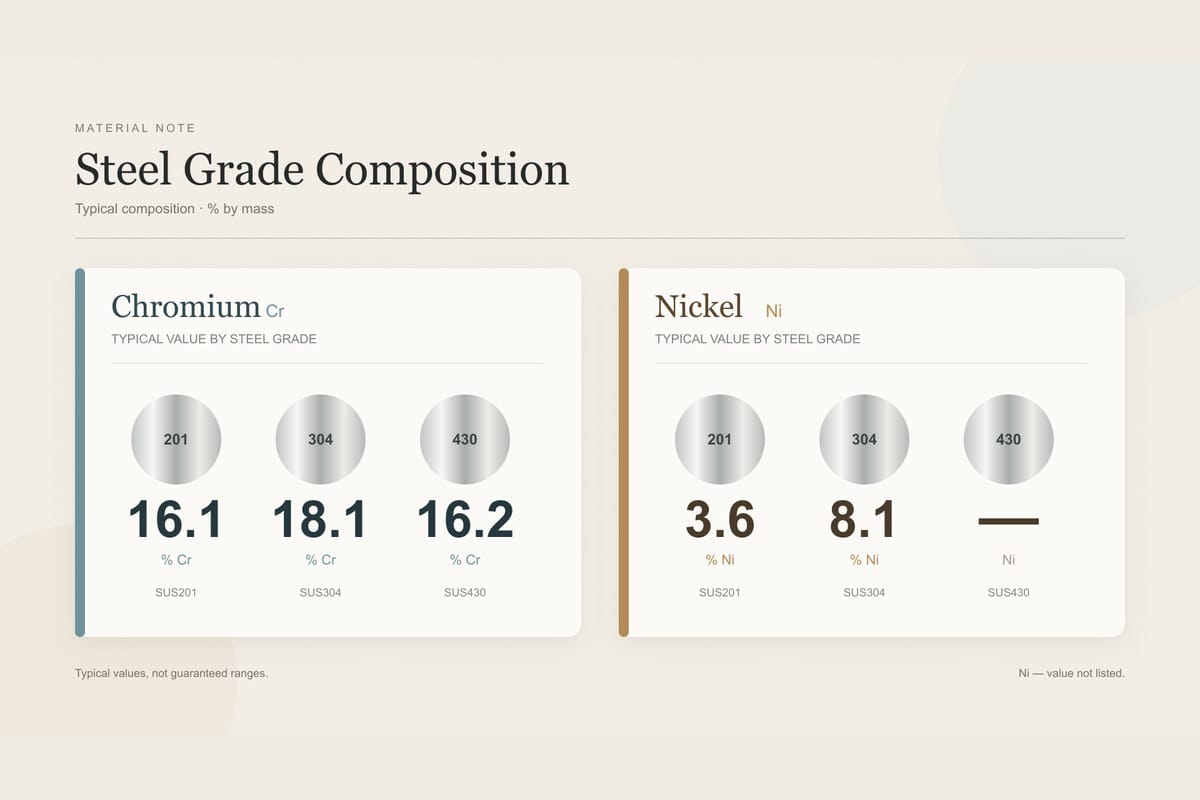
Both 201 and 304 are austenitic stainless steels, but they reach that structure differently:
| Element | 201 | 304 |
|---|---|---|
| Chromium | ~16–18% | ~18% |
| Nickel | ~1–5% (low) | ~8–10% (high) |
| Manganese | ~5.5–7.5% (high) | ~2% (low) |
| Series | 200 series | 300 series |
The headline difference is nickel. 304 uses nickel for corrosion resistance and that bright, stable finish. 201 replaces most of the nickel with cheaper manganese and nitrogen — which is why it costs less, but also why it doesn’t resist corrosion as well.
201 vs 304 head to head
| Factor | 201 | 304 |
|---|---|---|
| Corrosion resistance | Good (dry/indoor) | Excellent |
| Resistance to acids, salt, dishwashers | Lower — can spot/rust over time | High |
| Finish & luster | Good | Brighter, more premium |
| Price | Lower & more stable | Higher (tracks nickel price) |
| Strength / hardness | Higher (work-hardens) | Slightly lower |
| Food safe | Yes | Yes |
| Best for | Budget lines, light/indoor use | Premium lines, hospitality, export |
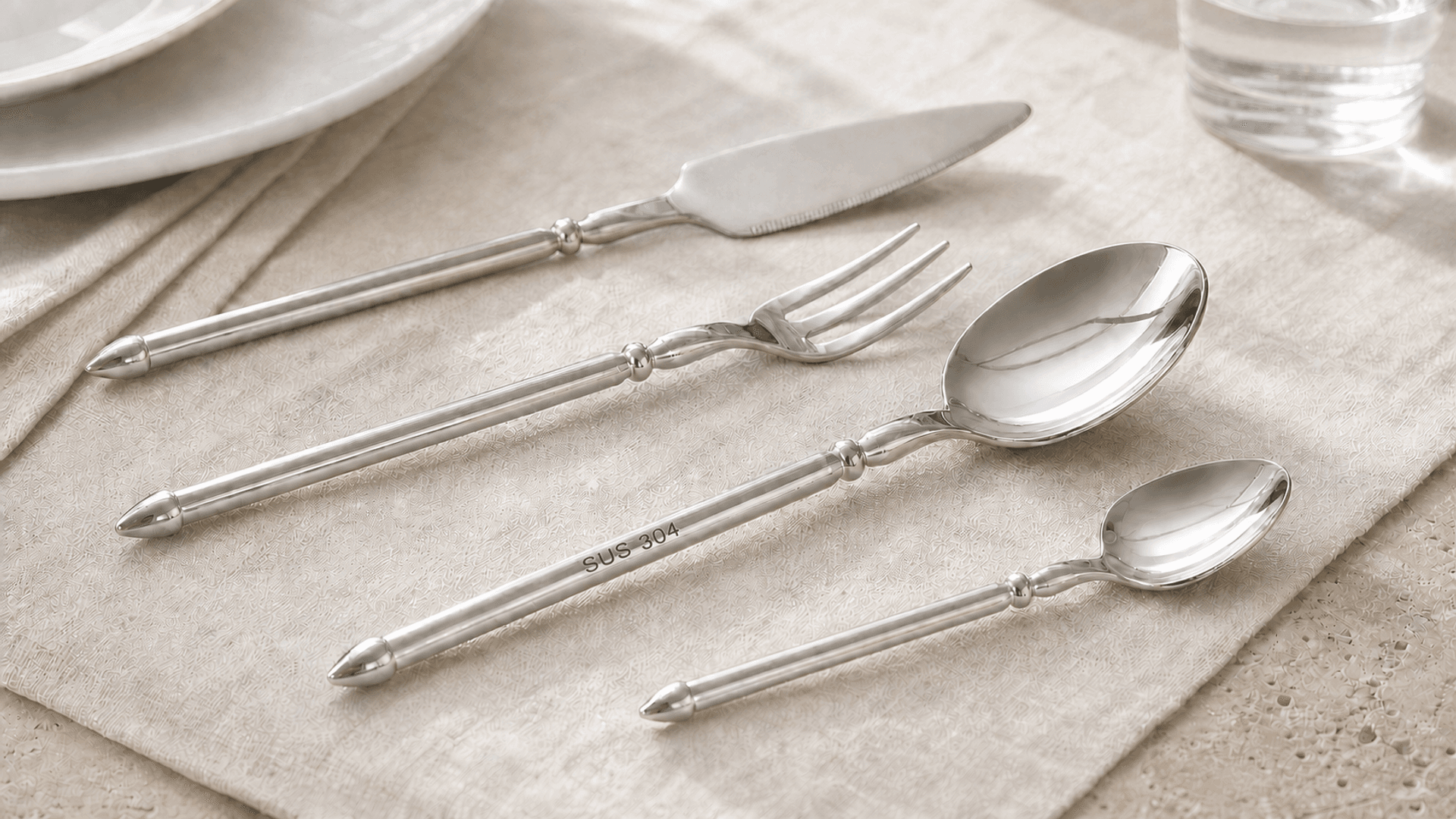
When to choose 304
Pick 304 when:
- You sell to upscale hotels, restaurants, or retail brands where finish and longevity define the product.
- Items face acidic foods, salt, or daily dishwashing.
- You export to markets with strict food-contact expectations (EU/US).
- You’re in a humid or coastal climate where corrosion is a risk.
It costs more, but it protects your brand from returns and complaints down the line.
When to choose 201
Pick 201 when:
- You need a competitive price point for a value or entry line.
- Items are for lighter or indoor use and won’t face harsh washing or acidic foods.
- Your market is highly price-sensitive and buyers prioritize cost over longevity.
Many distributors run both — a 304 premium line and a 201 value line — to cover more of the market with one supplier.
→ See how grade fits into volume pricing in our wholesale tableware guide.
⚠️ The trap: paying for 304 and getting 201
Because 201 and 304 look nearly identical, some suppliers quote 304 and ship 201 to cut cost. It’s one of the most common quality disputes in stainless tableware sourcing.
How to protect yourself:
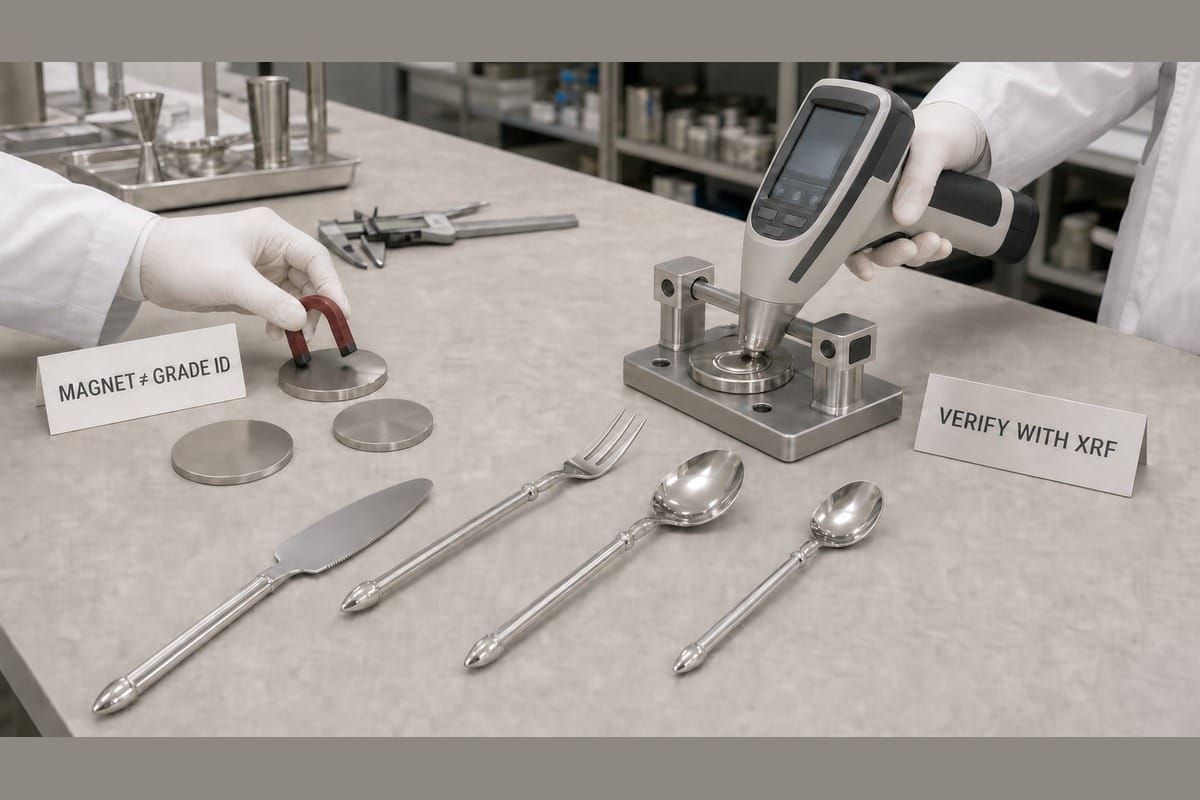
- Don’t rely on a magnet. Both are largely non-magnetic, so a magnet test does not reliably tell 201 from 304. This is a myth.
- Use a nickel/grade test kit or an XRF analyzer. A chemical grade-test solution or a handheld XRF gun can confirm the alloy in seconds.
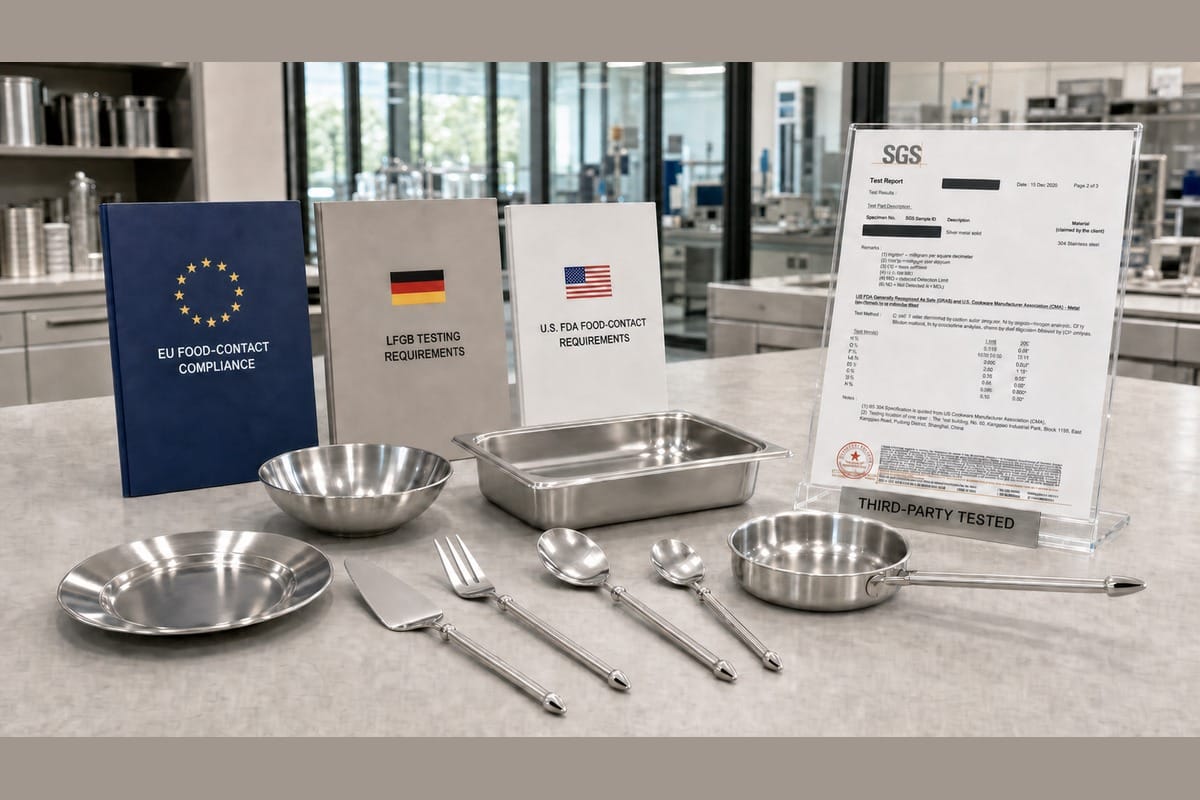
- Buy from a supplier who states the grade in writing — and welcomes verification. We tell you exactly which grade you’re getting, can provide test reports per order, and accept customer-designated third-party inspection at our factory.
Transparency about grade is the simplest sign of an honest supplier. If a price looks too good for “304,” it’s often 201.
Does 201 stainless steel rust?
It can, more readily than 304, especially with prolonged exposure to moisture, salt, or acidic foods, or with aggressive dishwashing. For dry, indoor, light-use items it performs well; for demanding daily food service, 304 is the safer choice.
FAQ
Is 201 stainless steel food safe?
Yes, 201 is food-grade. The practical difference versus 304 is corrosion resistance and longevity, not basic food safety.
Can you tell 201 and 304 apart with a magnet?
No — both are mostly non-magnetic, so a magnet isn’t reliable. Use a grade-test solution or XRF analyzer.
Why is 304 more expensive than 201?
304 contains much more nickel, the priciest input. That’s also what gives it better corrosion resistance and finish.
Which grades can you produce?
Our standard tableware comes in 201 and 304, and we also manufacture 430, 316L, and tri-ply stainless on request. Ask us about grade options.
Get the right grade — and proof of it
Yorkers International manufactures stainless steel tableware, kitchenware, and hotel supplies in 201, 304, and beyond — with the grade stated clearly, test reports available per order, and third-party inspection welcome. Exporting to 50+ countries for over 10 years.
👉 Request samples & a quote · Read more on stainless steel grades (18/10 vs 18/0) · Browse our product range.