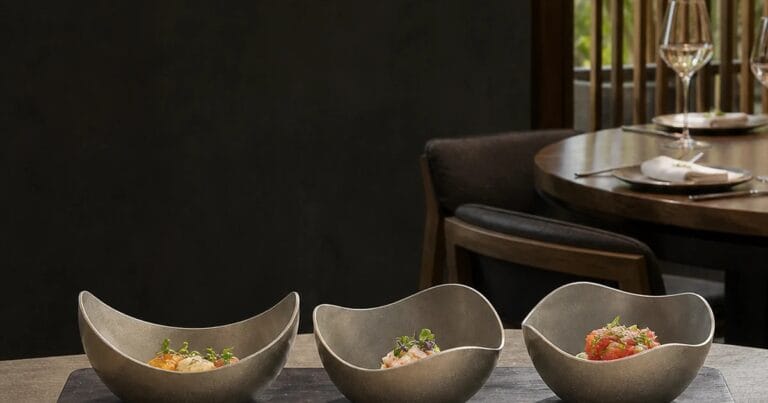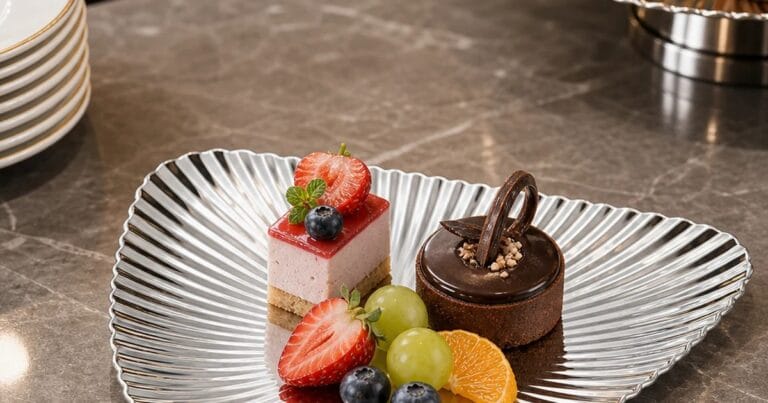
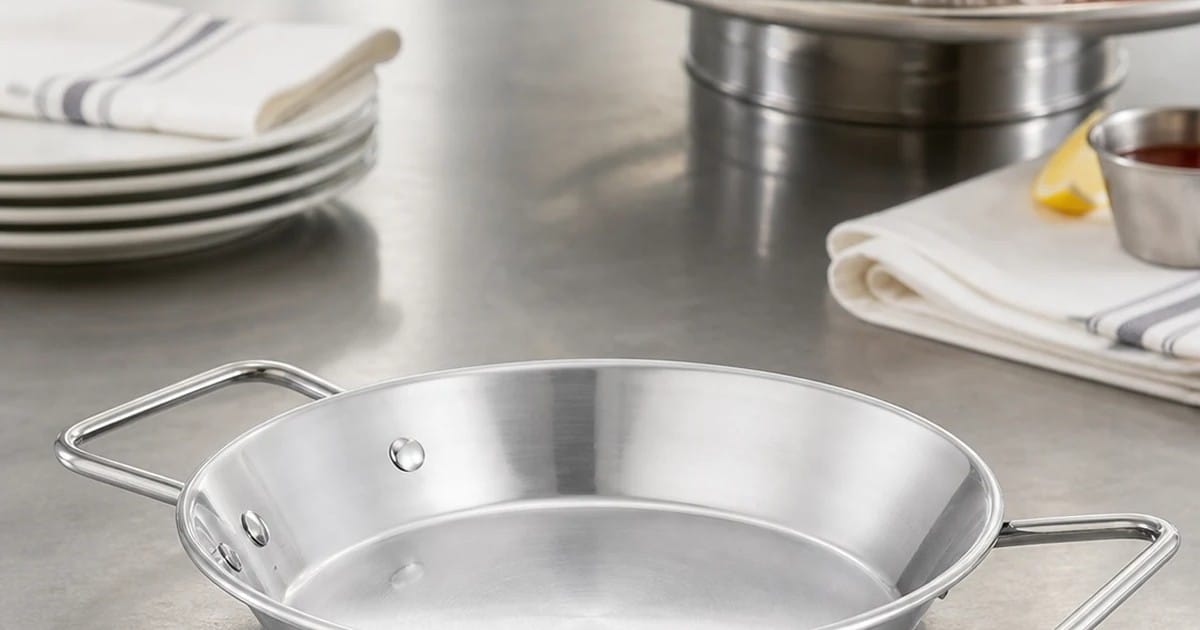
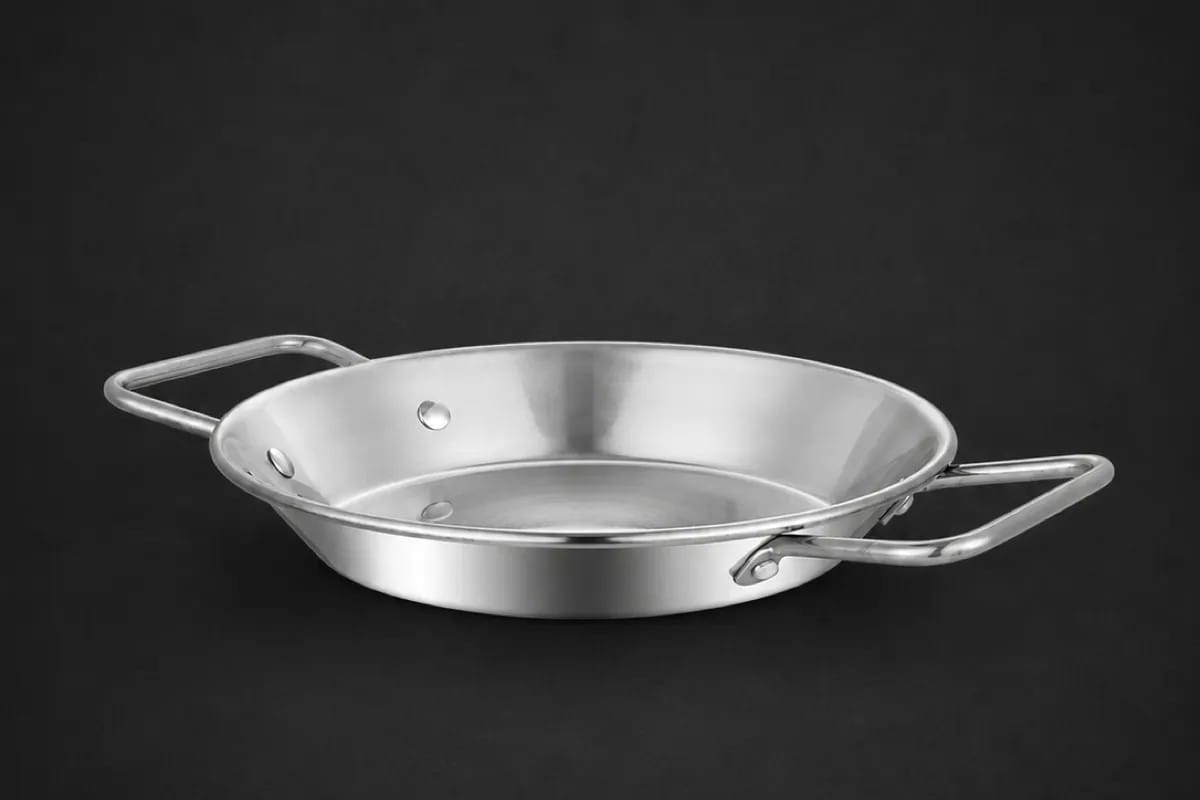
A seafood pan has one clear job on the line: present shellfish, crustaceans and chilled displays openly and generously, while staying practical for staff to carry, replenish and clean. That combination pushes seafood service toward one specific format — the wide, shallow, round presentation pan with side handles — rather than deep bowls or standard gastronorm trays.
For buyers at seafood restaurants, banquet operators and catering companies, the real sourcing question is size. A pan that is too small crowds a king crab cluster; a pan that is too large empties a display and wastes counter space. This guide walks through how to plan a size mix across a full range, using the Stainless Steel Seafood Pan series — a wide shallow round pan available in nine diameters from 20 cm to 36 cm — as the working example.
Start with the display, not the pan
Seafood presentation is built around abundance. Oysters on ice, a shrimp ring, a lobster centerpiece, a shared crab platter — each of these needs open surface area more than depth. Before comparing products, map what your venue actually serves:
- What goes on the pan? Whole shellfish clusters, arranged chilled seafood, or cooked dishes served family-style. Each needs a different footprint.
- Is the pan carried in front of guests? Banquet and display service means the pan is lifted regularly — weight and handle design matter as much as looks.
- How many pans run at once? A raw bar, a buffet ice display and a plated banquet course each demand a different size mix.
- What sits next to the pan? Ice beds, garnish, wedges of lemon and dipping bowls all claim counter space around the pan.
- How will the goods be shipped and stored? Unit weight, carton quantity and carton dimensions should be checked before the order, not after.
Answering these questions first prevents the most common sourcing mistake in seafood service: buying a single attractive size and discovering it cannot cover both the shared centerpiece and the individual portions on the same menu.
Work through the nine-size range
This series covers a wide span: 20 cm, 22 cm, 24 cm, 26 cm, 28 cm, 30 cm, 32 cm, 34 cm and 36 cm in diameter. That range is best read as three service tiers:
- 20–24 cm — individual and small-group portions: a personal shellfish platter, oyster accompaniments, sauces and garnish stations, or a two-person shrimp plate.
- 26–30 cm — everyday seafood service: a shared crab or crawfish platter, a shrimp ring on ice, a lunch-portion catch of the day.
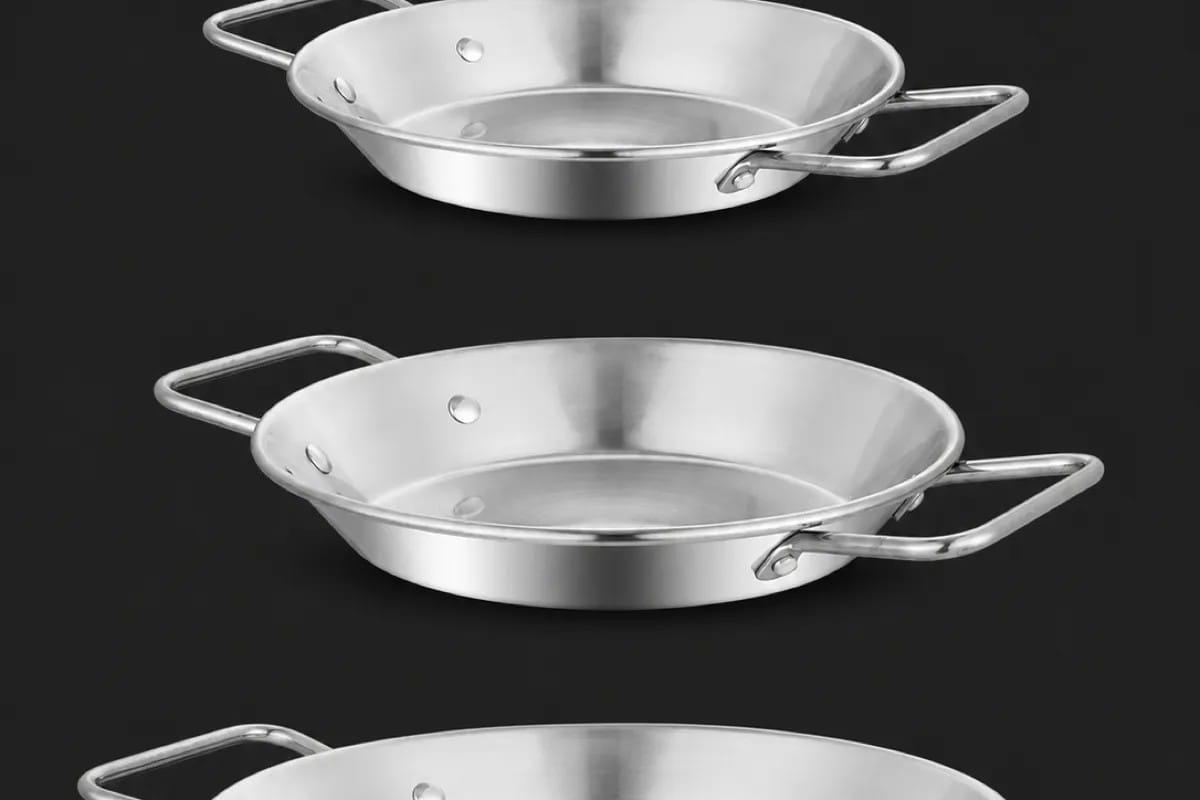
- 32–36 cm — banquet and display centerpieces: king crab clusters, a lobster medley, or a full chilled seafood display where the pan itself anchors the table.
The published specification for each size is listed below. Note that the packing changes mid-range: smaller sizes pack 40 pieces per carton, larger sizes 30 pieces per carton — a detail that matters for order consolidation and freight planning.
| Diameter | Unit weight | Qty/carton | Carton size (cm) | Gross/net weight |
|---|---|---|---|---|
| 20 cm | 390 g | 40 | 26×26×58 | 17.6 / 15.6 kg |
| 22 cm | 415 g | 40 | 28×28×58 | 18.6 / 16.6 kg |
| 24 cm | 470 g | 40 | 30×30×59 | 20.8 / 18.8 kg |
| 26 cm | 480 g | 40 | 32×32×56 | 21.2 / 19.2 kg |
| 28 cm | 605 g | 40 | 33×33×60 | 26.2 / 24.2 kg |
| 30 cm | 704 g | 30 | 35×35×48 | 23.1 / 21.1 kg |
| 32 cm | 755 g | 30 | 35×35×45 | 24.7 / 22.7 kg |
| 34 cm | 847 g | 30 | 37×37×43 | 27.4 / 25.4 kg |
| 36 cm | 912 g | 30 | 39×39×43 | 29.4 / 27.4 kg |
A practical approach for a full venue: pick one size per service tier rather than stocking every diameter. A 22 / 28 / 34 cm mix, for example, covers individual, shared and banquet display roles with a single coherent look across the line.
Why wide and shallow works for seafood
The wide shallow format earns its place in seafood service for reasons a deeper vessel cannot match:
- Surface area sells. A flat spread of shellfish reads as generous; the same quantity stacked in a bowl reads as cramped.
- Guests see the product. Shrimp, oysters and crab are expensive precisely because of how they look. A shallow pan keeps nothing hidden.
- Portioning is visible. Staff can replenish and portion quickly when the whole display is in view.
- Ice and garnish work better. Crushed ice beds, lemon wedges and dipping cups sit naturally on a wide flat surface.
- Stacking and storage stay simple. Shallow pans nest compactly between services.
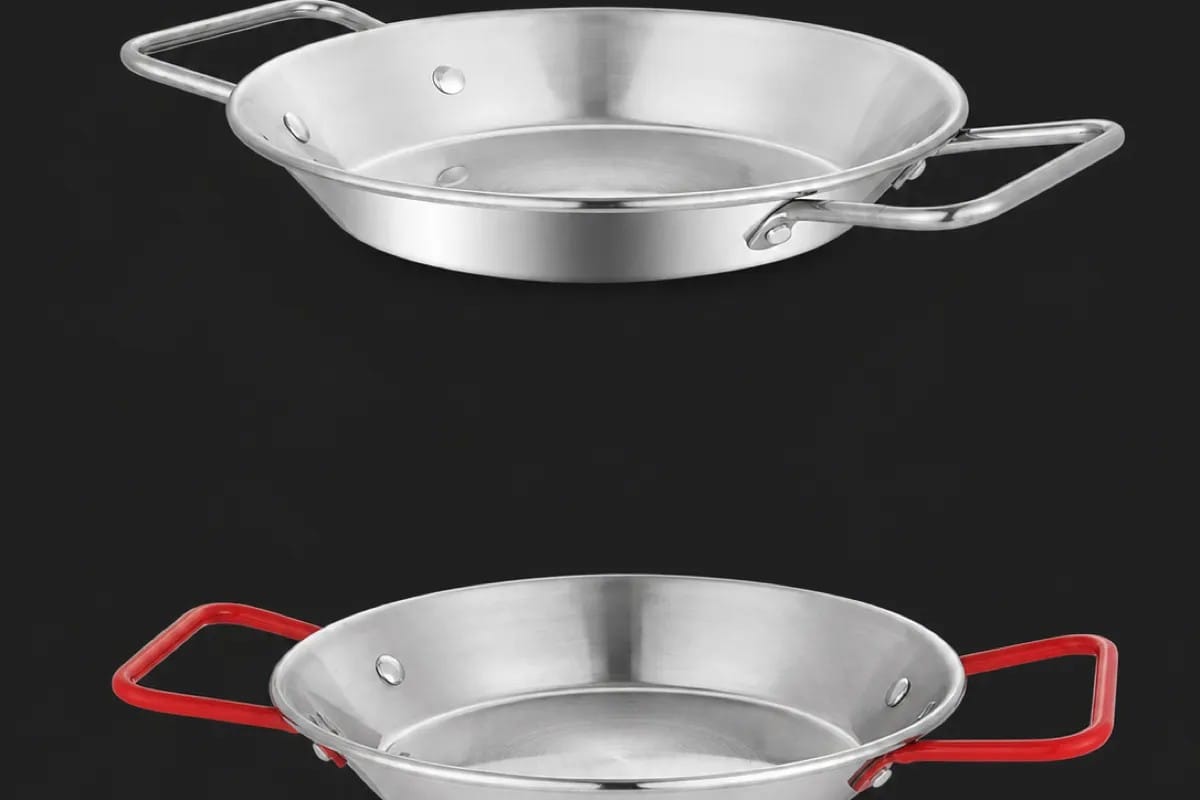
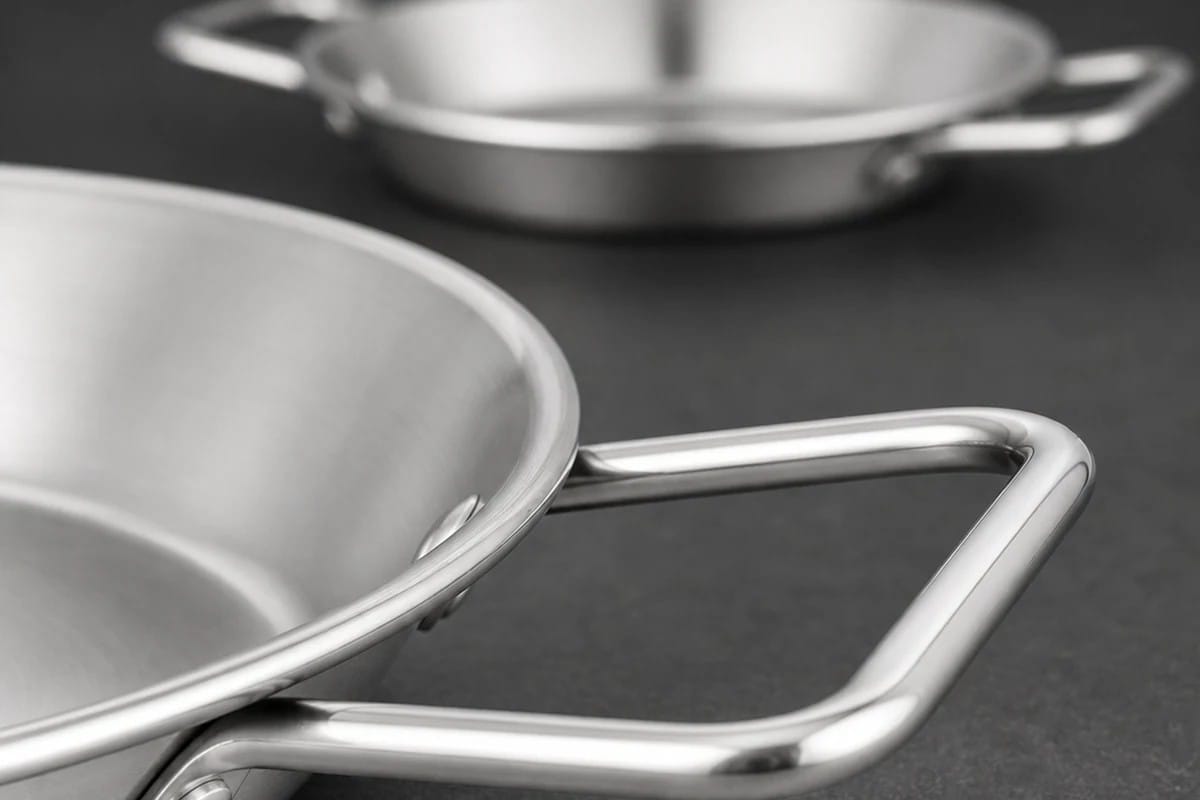
The other defining feature of this format is the handle. This series uses two ring handles mounted opposite each other on riveted ear tabs, so a loaded 36 cm pan of iced seafood can be carried two-handed and set down safely at the table or on the display. The handle color is a sourcing option as well — steel-finish handles keep a fully stainless look, while red handles add a visual accent and improve grip identification on a busy line.
Check the build details that survive daily service
A seafood pan works in one of the harshest environments in commercial kitchens: brine, ice, citrus and repeated dishwashing. Review the construction points that determine longevity:
- Riveted ear tabs. Handles fixed with rivets, not adhesive or spot welds alone, hold up to repeated carrying of heavy iced loads.
- Ring handle clearance. The rings must clear the pan wall enough to grip with a gloved or wet hand.
- One-piece packing. Each pan ships in its own OPP bag, which protects the finish during transit and makes item-level inspection straightforward on receipt.
- Finish consistency. Ask for photos of multiple diameters together to confirm the surface finish is consistent across the size range you order.
For the exact stainless steel grade supplied, and for compatibility with specific heat sources, confirm in writing for the selected order before production. These details vary by specification and should be agreed with the supplier rather than assumed from a listing.
Use packing data as a purchasing input
The carton table above is more than logistics trivia — it changes how you order. Sizes 20–26 cm pack 40 units per carton, so a single carton covers a full station set for a small restaurant. Sizes 30–36 cm pack 30 per carton, and carton footprints get wider and shorter as diameter grows.
Before confirming an order, request written confirmation of:
- the selected size mix and quantity per size;
- inner packing and protective materials;
- final carton dimensions and gross weights for the mixed order;
- labelling and marking requirements;
- any logo, packaging or presentation customisation.
Yorkers International manufactures this series in Shenzhen, China, and provides full OEM/ODM support for logo, packaging and design. Commercial terms and exact specifications should be confirmed per order rather than assumed from the general listing.
Ask what the product page does not answer
A competent buyer’s RFQ for seafood pans should always include:
- Which stainless steel grade is supplied for the selected version?
- Is the pan compatible with the intended heat source (chilled display only, or warm holding)?
- What is the wall thickness for each selected size?
- What handle color option applies — steel or red — and can sizes be mixed in one order?
- Which test reports and food-contact documentation can be supplied for the order?
- Can the buyer arrange a third-party factory inspection before shipment?
Yorkers International exports to more than 50 countries, supplies test reports per order as requested, and welcomes third-party factory inspection. These are reasonable questions for any serious supplier to answer in writing.
Build a range, not a one-off purchase
The strongest seafood programs use a coordinated pan range: small pans for sauces and individual platters, mid pans for shared service, large pans for display centerpieces. A single 36 cm pan cannot serve every role, and nine random sizes create storage and replacement complexity. The three-tier logic — portion, share, display — is the simplest way to buy a coherent set.
For distributors, the nine-size span and mixed packing (40/30 per carton) also support a structured assortment: sample sets across the range, volume on the fast-moving 24–30 cm sizes, and display-grade stock in 32–36 cm.
Final checklist before you request a quote
- [ ] The service roles (portion / share / display) are defined.
- [ ] The size mix is selected across the 20–36 cm range.
- [ ] Unit weight, carton quantity and carton dimensions have been checked for the selected mix.
- [ ] Handle option (steel or red) is specified.
- [ ] Stainless steel grade and heat-source compatibility are confirmed in writing.
- [ ] Custom logo, packaging or design requirements are specified.
- [ ] Test reports and inspection arrangements are discussed before order confirmation.
Need a seafood pan quotation or sample plan?
The Stainless Steel Seafood Pan series covers nine published diameters from 20 cm to 36 cm, with unit weights and carton data listed by size. Share your size mix, application and packing requirements with Yorkers International, and the team can help prepare the appropriate product and quotation discussion.