
# How to Choose Slanted Pedestal Sauce Bowls for Buffet and Condiment Service
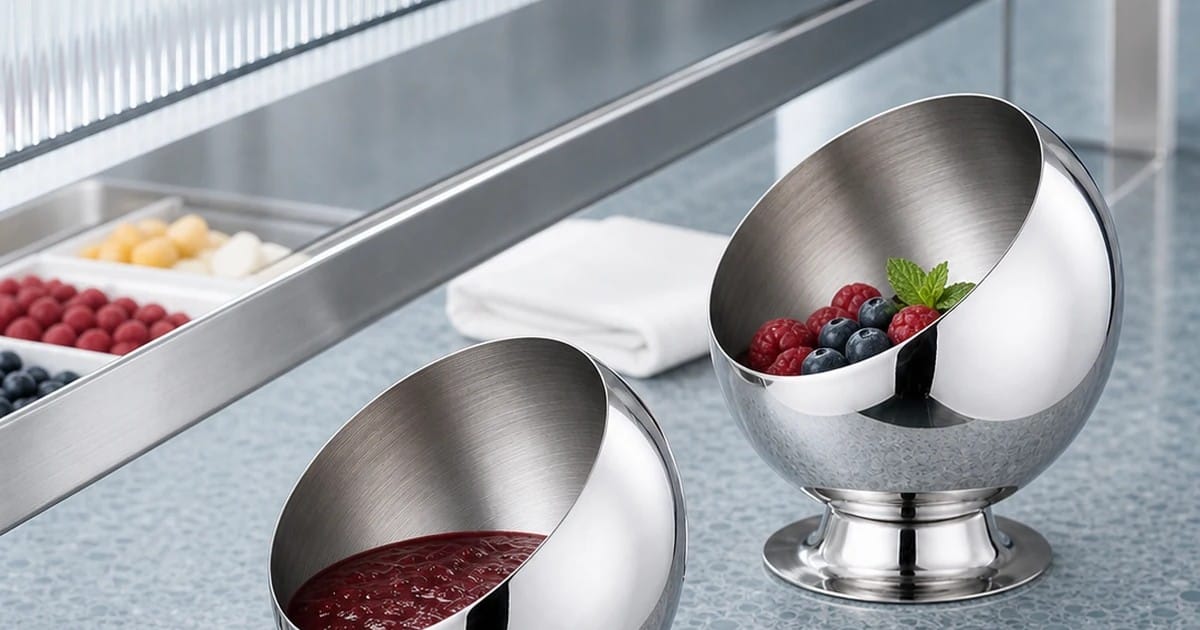
A sauce bowl seems like the smallest decision on a buffet line — until the line opens. The bowl a guest reaches for at the sauce station affects flow, portion control, presentation and reset speed. That is why the slanted pedestal format has become a recurring choice in hotel breakfast counters, cold buffets and catering setups: the diagonal opening faces the guest, and the pedestal raises the bowl into the presentation instead of leaving it sunk into the counter.
This guide gives hospitality buyers and distributors a practical checklist for sourcing slanted pedestal sauce bowls, using the [Stainless Steel Pedestal Slanted Sauce Bowl Series](https://yorkers-intl.com/product/stainless-steel-pedestal-slanted-sauce-bowl-series/) from Yorkers International as a concrete example of how to review a three-model range before requesting a quote.
## Start with the service role, not the product photo
Before comparing finishes, define where the bowl will work. A breakfast sauce station, a cold-buffet garnish line and a catering sample program all use sauce bowls differently — and they need different opening widths and heights.
A useful sourcing brief answers five questions:
1. **What will the bowl hold?** Sauce, condiments, garnish, fruit or samples each demand a different useful opening and depth.
2. **How will the guest reach it?** The slanted format presents the opening toward the service side; confirm this matches your counter orientation.
3. **How many bowls per station?** A coordinated three-size range is easier to plan than unrelated individual bowls.
4. **What visual direction does the venue require?** The mirror-polished exterior reads more formal than a satin or matte finish.
5. **How will the goods be packed and stored?** Unit weight, individual boxes and outer-carton data matter before an order is placed.
This prevents the most common procurement mistake: selecting one attractive bowl image first and discovering later that the size range or packing data does not fit the service plan.
## Review the size range as a presentation system
For condiment and sauce service, a series usually offers more flexibility than a single bowl. Smaller pieces support individual sauces and garnish; larger pieces can anchor a fruit or condiment cluster.
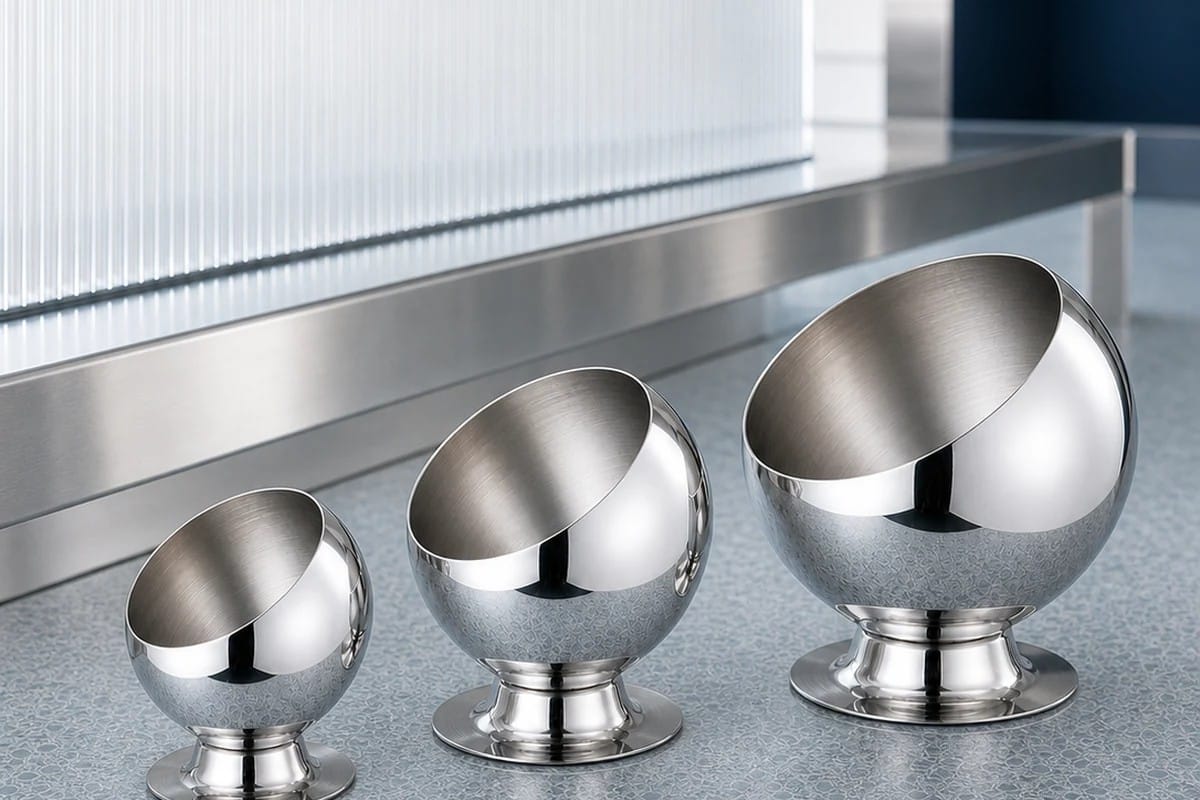
The Stainless Steel Pedestal Slanted Sauce Bowl Series is offered in three models:
| Model | Opening | Total height | Base | Unit weight | Individual box | Outer carton |
|—|—:|—:|—:|—:|—|—|
| 14 | 11.5 cm | 14.5 cm | 11.2 cm | 420 g | 14.5 × 14.7 × 14.3 cm | 36 pcs / 60 × 45 × 45 cm / N.W. 15.1 kg / G.W. 19.1 kg |
| 18 | 15.6 cm | 18.0 cm | 11.2 cm | 610 g | 18.3 × 18.4 × 16.8 cm | 24 pcs / 76 × 38 × 52 cm / N.W. 14.6 kg / G.W. 18.6 kg |
| 22 | 18.6 cm | 21.5 cm | 11.2 cm | 940 g | 22.3 × 22.2 × 19 cm | 18 pcs / 68 × 46 × 59 cm / N.W. 16.9 kg / G.W. 20.9 kg |
All three models share the same 11.2 cm base, so the presentation height rises with the model while the footprint stays consistent across the series. Each unit is packed in one individual kraft paper box — a detail that matters for hotel projects where units are issued to outlets individually.
The figures support a first layout discussion, but they are not a substitute for a buyer’s own service plan. Confirm the selected models and quantity mix against the menu and counter layout before ordering.
## Evaluate the slanted form from the guest’s point of view
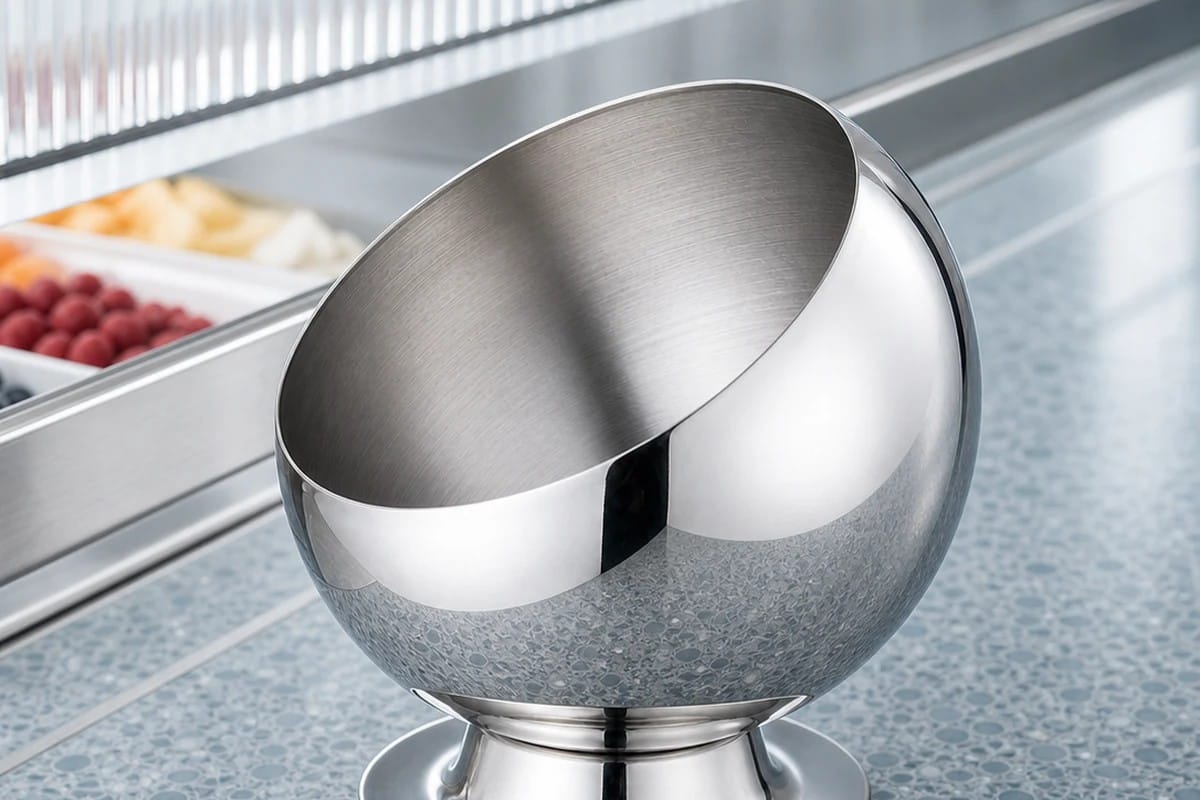
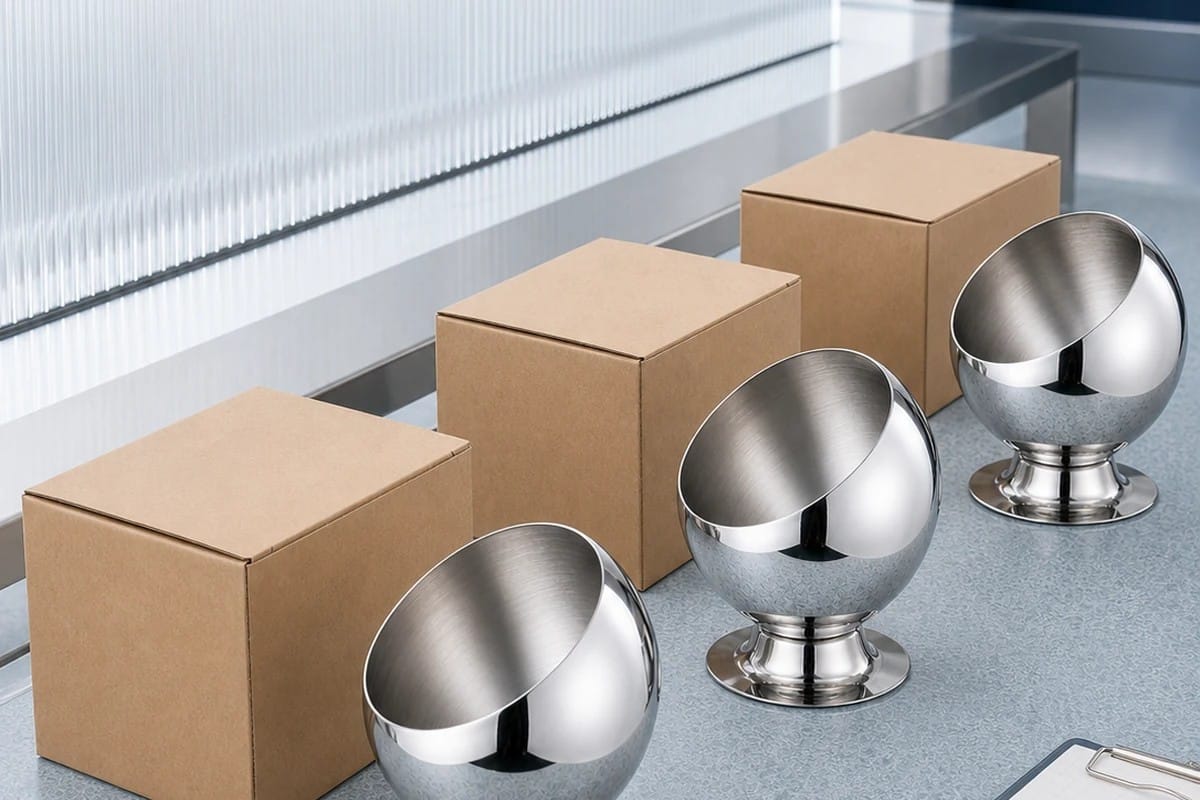
The bowl profile affects service even before food is added. The near-spherical body with a guest-facing diagonal opening does two things on a real line:
– **Access.** The slanted opening presents contents toward the guest side, so a spoon enters at a natural angle instead of over a vertical rim.
– **Presence.** The short flared pedestal raises the globe body above the counter, so the bowl reads as part of the display rather than sitting flush with the surface.
This series pairs a mirror-polished exterior with a satin interior. When reviewing a design like this, ask for images that show:
– the full bowl from above and at table height;
– the diagonal opening orientation;
– the finish in neutral light, inside and outside;
– all three models shown together;
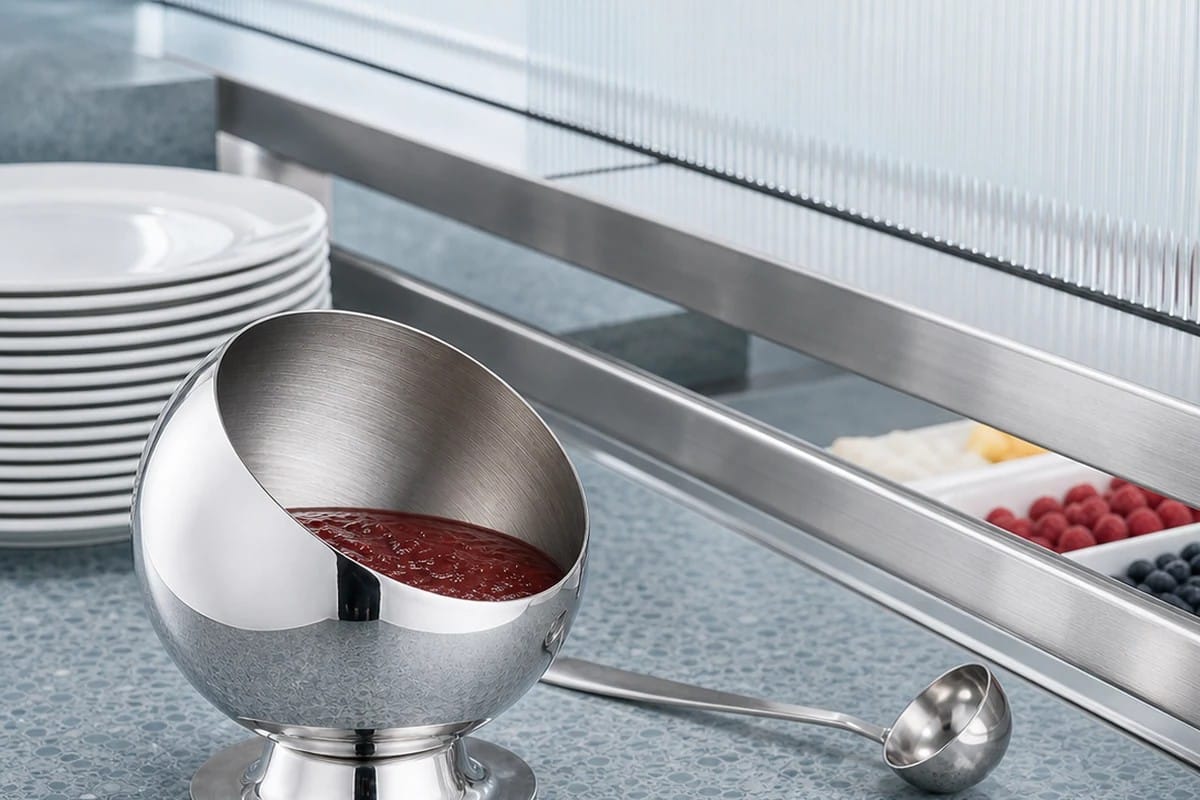
– the product in an actual service setting.
Photos support the design decision, not the technical review. A sample remains the only reliable way to judge handling, cleaning and reset routine.
## Match the bowl to the flow of service
A sauce-bowl series should be reviewed as part of a working line. Start by mapping the guest journey: where guests serve themselves, where staff replenish, and where visual height is needed to separate one condiment from another.
Model 14 suits individual sauce and garnish portions. Model 18 supports multi-condiment stations and breakfast lines. Model 22 can act as a stronger visual anchor for fruit or garnish clusters. The exact assignment depends on the menu, serving utensils and replenishment routine — request samples to confirm the fit for your own setup before finalising an order.
The pedestal and bowl body are engineered as one welded unit. Confirm with a sample how the bowl handles your dishwasher process, and how the pedestal foot sits on your counter surfaces.
## Treat packing information as a purchasing input
Packing is frequently left until the last stage of a quotation. For distributors, hotel projects and repeat orders, that is too late. The published data for this series — individual kraft boxes and outer-carton quantities of 36, 24 and 18 pieces by model — allows a buyer to begin warehouse and consolidation planning before the supplier prepares a final quotation.
Before confirming an order, request written confirmation of:
– the selected model mix and quantities;
– inner packing and protective materials;
– final carton dimensions and gross weight;
– labelling requirements;
– any logo, packaging or custom presentation requirement.
Yorkers International provides full OEM/ODM support for logo, packaging and design. The exact specification and commercial terms should be agreed for the selected order, rather than assumed from a general product listing.
## Ask the technical questions the product page does not answer
A good product page speeds up sourcing, but a serious buyer should not infer missing facts. The current source material for this series identifies it as stainless steel with the dimensions, weights and carton data above. It does **not** state the alloy grade, capacity, thickness or required documentation as fixed product facts.
Those details should be asked and confirmed before purchase. A practical request-for-quote checklist includes:
1. Which stainless steel grade is supplied for the selected version?
2. What capacity applies to each model?
3. What finish variations or logo options are available?
4. Which test reports can be supplied for the order as requested?
5. Can the buyer arrange a third-party factory inspection before shipment?
Yorkers International manufactures stainless steel tableware, kitchenware and hotel supplies in Shenzhen, China, and exports to more than 50 countries. Test reports can be provided per order as requested, and third-party factory inspection is welcome.
## Build a condiment range, not a one-off purchase
The best commercial result usually comes from a coherent range. Buyers can use one collection to create a consistent visual language across a breakfast counter, a cold buffet and a catering catalogue. The three-model format of this series supports that approach: choose the sizes needed for the menu rather than forcing every use into one bowl.
For distributors, this also creates a clearer assortment story:
– Model 14 for individual sauce and garnish portions;
– Model 18 for everyday condiment stations;
– Model 22 for prominent fruit or garnish presentation;
– one finish direction that ties the assortment together.
For project orders, keep the same decision record with the quotation: selected models, planned application, requested finish, packing requirements and the technical points still awaiting confirmation.
## Final checklist before you request a quote
Use this short checklist when comparing slanted pedestal sauce bowls:
– [ ] The intended food and service role are defined.
– [ ] The required model mix is selected.
– [ ] Opening, height, base, unit weight and carton data have been reviewed.
– [ ] Finish and opening orientation have been checked in clear product images.
– [ ] Alloy grade, capacity and packing have been requested in writing.
– [ ] Custom logo, packaging or design requirements are specified.
– [ ] Required test reports and inspection arrangements are discussed before order confirmation.
## Need a sauce-bowl quotation or sample plan?
The [Stainless Steel Pedestal Slanted Sauce Bowl Series](https://yorkers-intl.com/product/stainless-steel-pedestal-slanted-sauce-bowl-series/) offers three published models for hotel buffet and condiment service. Share your preferred sizes, application and packing requirements with Yorkers International, and the team can help prepare the appropriate product and quotation discussion.
👉 **[Request a quote or sample discussion](https://yorkers-intl.com/contact-us/)**